BackJay Yu

Jay Yu

ChainFeeds
2026-09-11 01:58:25

ChainFeeds roundup tracks DeFi registration bill, compute-market pricing and Ethereum’s August EIP progress

ChainFeeds’ Sept. 11 research briefing combined a policy news roundup with five long-form pieces spanning meme launchpads, AI compute markets, post-quantum zk proofs, tokenized equities on Solana, and Ethereum core development. The newsletter highlighted a revised CLARITY Act proposed by Republican lawmakers that would require non-decentralized DeFi protocols to register with the CFTC, Polymarket’s first CFO hire tied to a planned $1 billion fundraising effort, updated tokenomics from FLOP, a reported $100 million investment plan by Nasdaq Ventures into Kraken parent Payward at a $21 billion valuation, and Bitrace’s note that Fulilai Guarantee has started removing money-laundering merchants, possibly due to OFAC sanctions. The research selections then moved across several themes. One focused on Robinhood Chain’s meme launchpad race, where Pons and LONG are pushing fee-sharing and tokenized-stock trading. Another, by Pantera Capital partner Jay Yu, argued that GPU compute could evolve into a commodity market with benchmark pricing similar to power markets. The briefing also covered a16z’s release of Lattice Jolt, a post-quantum zkVM built on lattice cryptography, Pump.fun’s rollout of custom quote assets including tokenized U.S. equities, and Four Pillars’ review of Ethereum’s August EIP pipeline, testnet work, and changing assumptions around Layer 2 networks.

130
ChainFeeds roundup tracks DeFi registration bill, compute-market pricing and Ethereum’s August EIP progress
Pantera Capit
2026-09-10 23:55:00

Pantera Capital says compute could become a hard currency for the AI economy

Pantera Capital partner Jay Yu argues that GPU compute is still in the early stages of financialization, but its market structure may develop in ways that resemble electricity and other physical commodities. In his view, compute is constrained by chip type, time, and geography, which makes it heterogeneous rather than perfectly fungible, yet still capable of evolving into a globally traded asset class over the next five to 10 years. The article maps the sector through layers including hardware providers, compute service operators, clusters, inference platforms, application companies, brokers, OTC desks, index builders, and derivatives venues. Yu draws repeated comparisons with U.S. power markets, where physical delivery, benchmark formation, and risk transfer tools emerged over time. He suggests compute markets may follow a similar path, with physical GPU delivery venues anchoring index construction and futures trading. The piece also describes Nvidia as a possible “central bank” for the compute economy because of its control over chip release cycles, utilization dynamics, and residual-value support policies. It identifies four broad product categories already taking shape: physical delivery, index products, derivatives exchanges, and financing tools such as lending, treasury structures, synthetic stablecoins, insurance, and other risk-transfer products. At the same time, it says the sector still faces major issues around transparency, basis risk, standardization, and quality verification.

80
Pantera Capital says compute could become a hard currency for the AI economy
Pantera Capit
2026-09-10 06:39:30

Pantera Says AI Compute Could Follow Oil and Power Into Finance, With Nvidia as a ‘Central Bank’

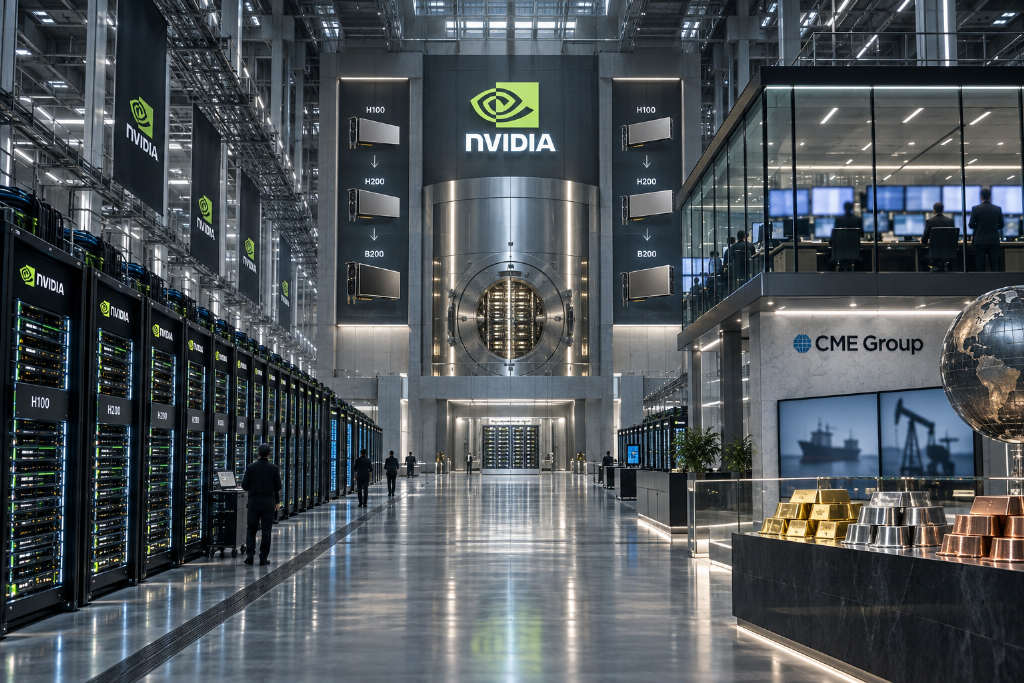
Pantera Capital investor Jay Yu argues that the market for AI compute is still traded in a highly primitive way despite trillion-dollar spending on data centers and compute infrastructure. In his view, GPU rentals and purchases still rely heavily on chat groups, OTC brokers, and one-to-one enterprise agreements, even as platforms such as SF Compute, Vast AI, and Runpod have emerged. He compares the current stage of the compute market to the early development of U.S. power and oil markets, where large physical demand came first and standardized contracts, pricing indices, futures, and hedging tools followed later. Yu says that over the next five to 10 years, compute represented by GPUs such as the H100, H200, and B200 could evolve from an internal IT expense into a standalone asset class that can be priced, traded, financed, and hedged. He also outlines a market structure spanning physical settlement platforms, pricing indices, derivative exchanges, and broader financialization vehicles. The report notes that CME Group has already announced a partnership with Silicon Data to plan futures products tied to GPU compute prices. Yu adds that Nvidia may sit above this system like a “central bank” because its product roadmap and residual value support can shape depreciation curves, financing conditions, and expectations around the future value of installed compute assets.

160
Pantera Says AI Compute Could Follow Oil and Power Into Finance, With Nvidia as a ‘Central Bank’
Pantera Capit
2026-09-10 00:17:22

Pantera's Jay Yu says compute markets are still early, with GPU trading largely off-exchange

Pantera Capital junior partner Jay Yu said in his essay, The Rise of Compute Markets, that compute and data center spending has already become a trillion-dollar category, yet GPU procurement still happens mostly through group chats, over-the-counter brokers, and bilateral agreements. He argued that the financialization of compute remains at an early stage because markets are constrained by SKU differences, time, and location. Over the next five to 10 years, he said, compute could evolve into a commodity-like asset class comparable to electricity or oil. Yu also outlined a possible market structure modeled on the power sector, describing a future stack of hardware, suppliers, and clusters. In that framework, he characterized new cloud providers as structurally short GPUs, while on-demand platforms and the application layer are long. He added that for every $100 spent by the application layer on inference, about $45 goes to the on-demand layer, about $50 goes to new cloud providers or the GPU layer, and about $5 goes to routing layers such as OpenRouter.

20
Pantera's Jay Yu says compute markets are still early, with GPU trading largely off-exchange